Tuesday, June 19, 2012

Red Riding Hood Romp


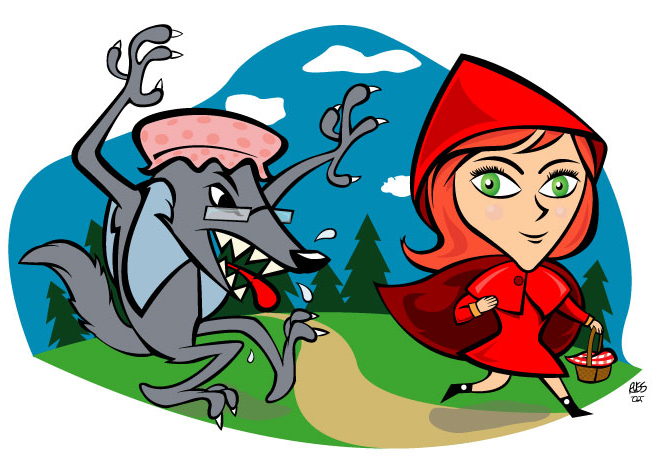
I was once part of a challenge given to authors to retell "Little Red Riding Hood" in 25 words or less. Competitive nut that I am, I was all over this task like a case of poison ivy. Here were my initial offerings:

Double haiku (22 words)
Ailing grandmother,
A wolf snack. Not appeased, Wolf
Gobbles Red. Dessert.

Snores lure Woodsman. 
Axe emancipates. Fill Wolf's
Greedy gut with rocks.

Red's Complaint (25)
I resent being eaten. And duped by a wolf wearing Granny's nightgown. It's embarrassing needing Huntsman to cut me free. Now my riding hood smells. 

Red Riding Nouns (25)
Cake, basket, hood;
Path, daisies, hut.
Door, nightgown, cap,
Clues, terror, meal.
Snooze, slumber, snore,
Ear, huntsman, axe,
Slit, release, joy!
Stitch, belly, rocks.
       Retribution.

Well, after my 25-word awesomeness, apparently the other writers complained that the task was impossible. (Pah! I spit upon their wordiness!) So the bar was raised (or lowered) to 50 words. Not one to sit idle, I produced the following:

Limerick (33)
"Go to Granny's. Don't speak to rough strangers."
So with basket, and no sense of danger,
     Red gave Wolf the address,
     Fell for Granny's nightdress,
Was cut free by a lone forest ranger.

Double Double Dactyl (Learn more about this fantabulous whimsical poetic form, or else what I've written won't make sense)

Higgledy-piggledy!
Little Red Riding Hood
Toting her grandmother's
Luncheon did romp.

Failing to spot Wolf's crude
Verisimilitude,
Red embraced "Granny" and 
"Granny" said, "CHOMP!"

[Alt ending 1]
Snaggedy-snorety!
Romulus Hunterman
Heard the wolf snoozing, and
Sliced that sly fox.

Granny and Red, now free
(Thumbing their noses at
improbability),
Stuffed Wolf with rocks.

[Alt ending 2]
Snaggedy-snorety!
Romulus Hunterman,
Heard the wolf snoozing, and 
"Swish" went his axe.

Granny and Red, now free,
Unnecessarily
Groveled before the man,
Offering snacks.

***
Fun, fun. Now if I could just get someone to pay me to do this all day. Chime in & vote for your favorite, or leave your own LITTLE "Little Red." 

Tuesday, May 15, 2012

Cow Breast Soup

My invitation to visit The Fenn School in Concord, MA, and conduct author presentations and workshops, unfolded in a roundabout way. I met a Fenn student, Johnny, at a local yard sale, where I happened to have a couple of my Splurch Academy books with me in my little lobster totebag, like so:


(My friends know I am never without my little lobster bag.)

Johnny's mother noticed my bag and said her son had enjoyed those books. I told her I'd written them, so she introduced me to her son whom, she said, was already a big Splurch fan. Later I sent this young man some Splurch tattoos and stickers, and told him that I'd be happy to visit his school. His teacher jumped right on it, and soon we'd scheduled a visit.

Johnny keeps a creative writing blog at Fenn (can I just pause to note how great that is?). His teacher shared with me the poem he wrote on his blog about my impending visit. With Johnny's parents' permission, I'm sharing his poem below:

She's Coming, by John 
What should I do  what should I do  
He's coming, I mean she's coming, she's really coming  
I read the book and now I'm going to have lunch with her what will it be pasta, salad, cow breast soup what if she doesn't like it she might get mad
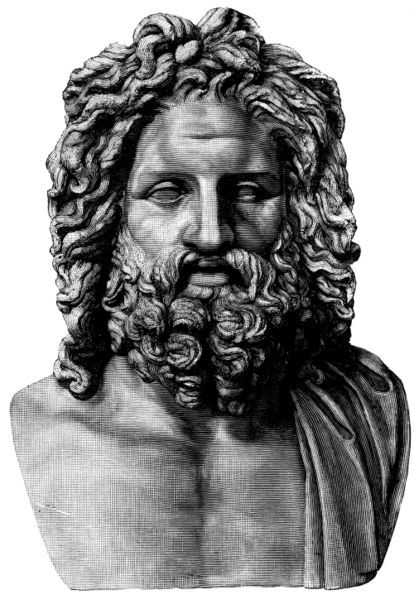
and destroy the world she might kill zeus what should I do 
what should I do

****
I showed this to my husband whose immediate response was, "No wonder he likes your books."

I loved this poem. I like the nutty kind of brilliant creativity that inspired it. Personally, I'm fond of an epic struggle in my poetry when I can get it, and if it pits me against the king of the gods, all the better. World? You're goin' down. Cow breast soup? Titans have clashed for less.


So be forewarned, all ye Olympian gods and Fenn kitchen chefs: behold, I come quickly, trailing destruction in my wake. Feed me worthy victuals lest I smite you with the rod of my wrath. Kids, line up after class for stickers and washable tattoos. They're buried somewhere here in my lobster totebag.


P.S.: For some actual footage of author visits where no carnage took place, visit my YouTube channel.  

Thursday, April 19, 2012

Recent reads (a rhapsody)


I'm always late. Late to blog, late to read the books the rest of the world raves about. Late to meetings, late with paperwork. Never late for meals. Here at last is a recap of some of my recent reads. More to follow soon. Judge for yourself whether I have good reason for chronic lateness, when such delicious distractions sit on my bedside table. 


The Underneath by Kathi Appelt
Another instance of being late to the party. This story kept me captive, and so did the writing. Either one would have been enough on its own, but the combination was compelling. I couldn’t put the book down. A tapestry celebrating the interconnectedness of nature and time, of living and dying, of love and pain, of relationships spanning generations, dramatized by a cast of creatures natural and mythical whose stories converged stunningly. Like a river that seems to meander on the surface, the poetic narrative often feels leisurely, yet an insistent undercurrent propels the players swiftly toward their fates. An impressive achievement; a piece of joy. Strongly recommended.


A Tale Dark and Grimm by Adam Gidwitz
In every school visit, I tell the kids that if they thing fairy tales are only for pink Disney princesses, they need to read their Grimm’s. Where else could so many body parts be hacked off and successfully reattached? Adam Gidwitz takes Hansel and Gretel on a dark, sinister journey through several of the original Grimms’ tales, where they test this limb-severing-and-grafting phenomenon to its ultimate limits. I’ve started mentioning this title now in my school visits. Strongly recommended, but maybe not for the squeamish.


I admire books that are unafraid to dive down deeply into strange territory and defy convention. Peter Nimble has a wonderfully trippy quality, with enigmatic settings, dark villainy, and a blind and gifted hero with the strangest of allies. A wooden box filled with eyes becomes a conduit to dark and perplexing adventures. So many memorable bits: the bay bobbing with bottles stuffed with unmet wishes; the teakettle rock; raven battles; the miniature horse-cat. (My sons have absconded with my copy so I’m sure my words aren’t spot-on.) Recommended.


The Wind in the Willows by Kenneth Grahame
The urge to reread this, for nostalgia’s sake, came upon me with, I expect, something like the yearning the Water-Rat felt for spring, or perhaps the call both Ratty and Mole heard from the piper at the gates of dawn. I know the story well, and I even understand how it works to uphold illusions of Edwardian English bachelor male gentility. Nevertheless, I just need to reread it now and then. In times past, Toad and his exploits have stolen stage center, for me, but this time it was the rhapsodic nature-bliss of Ratty and Mole that spoke to me. I had less patience for Toad this time around. The prose is lush; too lush, no doubt. But it was just what I wanted. I wish I had a Badger in my life, tucked in palatial underground Roman ruins, to turn to when times get tough.


Cold Cereal by Adam Rex
I’m an unabashed Adam Rex fan. If he’s going to write a book about an evil cereal company out to take over the world, featuring leprechauns and unicats and rabbit-headed men, and a genius girl wearing orthodontic headgear of such metallurgic beauty that orthodontists weep, and a boy whose name is Scottish Play Doe, and a secret, elite Masonic-like society of cereal cultists who chant about dragons, and movie stars who punch the queen of England, and children as experimental guinea pigs in the hands of men in pink suits, am I going to read it? You betcha. The start of a new series; sure to stay crispy even in milk.


When You Reach Me by Rebecca Stead
It seemed significant that I read this book on the day Dick Clark died, since his apparently agelessness was an important plot point. I’m always late to the party; the rest of the world knew this book was a treasure before I ever got around to reading it, but let me add my delight to the pile of offerings around this altar. I loved this book. Relativity and A Wrinkle in Time are both dear to me. A remarkable marriage of the realistic school novel with the fantastic, true to the essence of L’Engle’s book, which the novel frequently invokes. A novel fearfully and wonderfully made. My congratulations to Ms. Stead for every well-deserved accolade. Strongly recommended.


The Reluctant Widow by Georgette Heyer
** spoiler alert ** An escapist romp of a Regency romance! The main character, Elinor Rochdale, is excessively fond of exclamation marks! I was hard-pressed to find statements that did not employ them! Her favorite word was odious! She called the handsome, rich, imperious, undoubtedly well-washed and scented Lord Ned Carlyon odious on his every visit! Naturally he would insist on marrying her! What man could resist the allure of an exclamatory woman who finds him odious?!
 Forgive my snarking. A fun read, and a happy instance of a proud, poor, blue-blooded maiden boarding the wrong coach and ending up, not a governess, but a wife twice over. 


Friday, August 12, 2011

Alchemy and Meggy Swann, by Karen Cushman


Karen Cushman is a delight, and I could stop my review right there. The integrity and authority with which she embroiders unsentimentalized and yet hopeful, trimphant narratives of Elizabethan England -- about powerless girls, no less -- leaves me in awe and commits me to working harder at my own craft. Meggy Swann, unwanted by both her parents, is a cripple by birth foisted off upon her self-absorbed father, an amoral alchemist toiling to convert elements into gold. He barely takes notice of her existence. Her only friend is Louise, a crippled goose. But Meggy makes others in time, despite those who view her handicap as proof of an alliance with the devil. Roger Oldham, in particular, an apprentice to an actor, becomes her friend. Here's an exchange between them, trimmed a bit:

Meggy: "I am not your Mistress Swann, you tottering wretch."
Roger: "Fortunate that is for me, you mewling, flap-mouthed flax wench."
Meggy: "Gleeking swag-bellied maggot."
Roger: "Knoddy-pated whey face."
...
Meggy: "You bloviating windbag."
Roger: "You, Mistress Margret, are passing skilled at this matter of insults, you milk-livered minnow."
Meggy: "I grew up in an alehouse, you wart-necked mammering clap dish."

Much more was left out in the interests of space, but ... pure Hepburn and Tracy, that is! I don't remember when a book has transported and delighted me so well. Even if historical fiction isn't your young reader's mug of ale, urge Alchemy and Meggy Swann upon them. This gleeking swag-bellied maggot insists upon it.

Saturday, July 16, 2011

Marvelous Middle Grade Summer Reads, mid-July edition

I’ve read some wonderful middle grade novels so far this summer, and there’s a tall stack still waiting for me. My Son Number Two, who is my great reader, has confirmed all these endorsements. Kid tested, mother approved.


The Shadows: The Book of Elsewhere, volume 1, by Jacqueline West, 2010.
Olive is certain something’s moving inside the paintings on the wall of the rambling old house her parents just bought. Cats can talk, and mysterious glasses let Olive enter the paintings and talk to the sad and trapped paint people inside. A fun and frightful new series beginner.


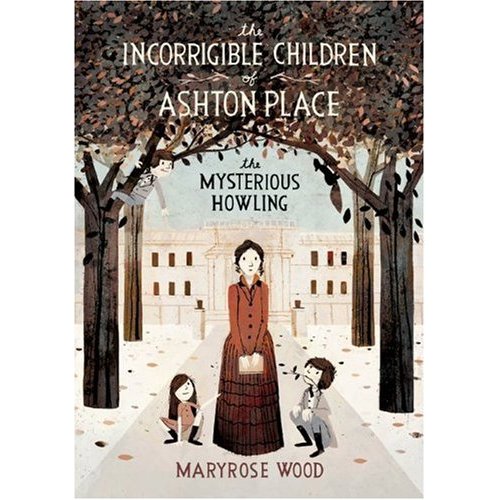
The Incorrigible Children of Ashton Place, book one: The Mysterious Howling, 2010, and book two, The Hidden Gallery, 2011, by Maryrose Wood.
These first two titles in a new series employ an original premise that successfully uses oh-so-familiar story elements in a whimsical Victorian setting and voice. Mystery, humor, and satire mix happily with sinister (yet unidentified) villains, high-minded governesses, frivolous society brides, and children actually raised by wolves. We gobbled these. In fact, my son and I squabbled over who got to read them first. The alpha wolf in our house won, naturally.


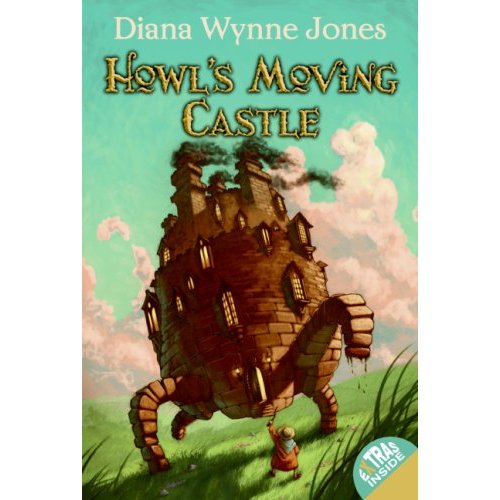
Howl’s Moving Castle by Diana Wynne Jones, 1986.
How did I miss this book? The first page was so scrumptiously brilliant I groaned with envy and squealed with delight, both together. When the Witch of the Waste casts a spell upon Sophie, an eldest daughter whose only talent seems to be making stylish hats, she turns into a ninety year old woman, and hobbles off to seek her fortune. The only place willing to give shelter to an old hag is the moving castle belonging to the notorious Wizard Howl, who is said to devour young girls. Newly old Sophie feels safe enough, and signs on as Howl’s cleaning lady. Classic Wynne Jones; this provocative collision-of-worlds tale rests solidly on fairy-tale bedrock but offers satisfying complexity, and irresistible, unforgettable characters. I’m reading a sequel now.

Wednesday, May 25, 2011

The Iron Ring by Lloyd Alexander

In 1998 my second son was born. He was a lazy nurser and didn't gain weight as fast as doctors would have liked. I settled on a plan to nurse that boy for as long as I could, feeding after feeding. Eventually he thrived, but the long hours, day and night while still raising a toddler made me loopy. I stumbled into the Bloomfield, NY public library and saw a shiny new children's book on display: The Iron Ring by Lloyd Alexander. Somehow I'd made it through my childhood never hearing of him. The cover intrigued me so I checked out the book, and started reading it during that night's wee-hour feedings. It was the first children's book I'd read in probably six or eight years.

It so completely enthralled and enchanted me that when I finished I looked up Lloyd Alexander's home address in Drexel Hill, Pennsylvania, and wrote him a gushing letter, telling him how his book had reminded me of my childhood dream of writing children's books someday. He very kindly wrote back and encouraged me. I began devouring all the other Lloyd Alexander titles I could find, and wrote to him again. Again, he responded with friendly warmth. I won't ever forget that thrill I felt. Most readers get this phase out of their systems at age 11, but I had never written a letter to an author before.

I just finished reading The Iron Ring again tonight. I am a children's author now. Perhaps I wanted to revisit that place where the dream first reawakened. I wish I still had a little baby to hold. Instead, I was up till midnight with a fifth grader finishing a project that was assigned a month ago, and is due tomorrow. Motherhood still demands its late nights. And I can't read the novel like I did the first time. I've read enough Lloyd Alexander to recognize his trademark formula: the hapless youth with grand dreams sets out on a wild adventure with a wise, clever, beautiful (but lower-rank) female, and acquires a motley crew of wise-cracking eccentrics, talking creatures, with maybe a mystic and a heavy thrown in. Hapless youth loses all, learns humility, defeats bad guy w/o bloodying his hands, gets girl. An appealing formula, to be sure, and yet in this second reading of the novel, I find myself flinching a bit at how readily the characters (based on Indian folklore) chuck their caste system by the end. And I've received enough criticism for love-at-first-sight in my own first novel not to cringe at it now.

But for all that, I still enjoyed the book this time around, even if not in the same wide-eyed, rapturous way. I am older. I read differently. I never wanted that to happen. But if I gush less, it doesn't mean I feel less. I can feel Alexander's commitment to compassion, even if he may not see all the risks inherent in appropriating another culture's folklore. I remember the compassion with which he wrote back promptly twice to a desperate house-bound young twenty-something lactating looney and said, "I'm sure you can be a writer someday!" And I remember that bringing books into the world is a generous act on behalf of the hungry readers who'll devour them. This is the part I sometimes forget, now that I'm more in the kitchen and less in the dining room. Dreams may lose sparkle over time, but they don't have to lose their meaning.


Lloyd Alexander, 1924-2007

Sunday, February 20, 2011

Ethan Frome by Edith Wharton

How shall I read Ethan Frome? It's my first Edith Wharton novel. My studies in early 20th Century American literature are grossly lacking, so I fear I lack the proper reader's tools to appreciate all that I should. I'm left mystified, and wishing for enlightenment. I can only unravel my questions by spoiling the plot thoroughly, so be warned.

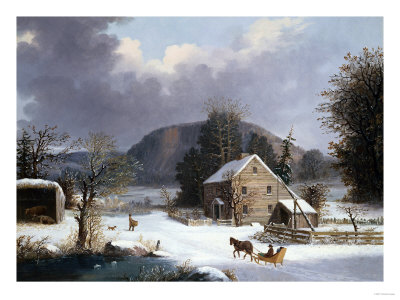
Ethan Frome tries to be a distinctively New England story, albeit with a decidedly particular slant on what it meant to be a New Englander. Wharton's own preface states: "…I had an uneasy sense that the New England of fiction bore little—except a vague botanical and dialectical—resemblance to the harsh and beautiful land as I had seen it. Even the abundant enumeration of sweet-fern, asters and mountain-laurel, and the conscientious reproduction of the vernacular, left me with the feeling that the outcropping granite had in both cases been overlooked." As an upstate New Yorker who now makes Massachusetts her home, I always know I've left my old home state for my new one when granite cliffs greet me just over the state line on I-90. New England has a stony spine underneath. I wonder what Wharton would think of our suburbs and strip plazas and central air today. Her "Starkfield" is a cold, stoic, frozen New England town. The landscape and the weather are a powerful presence, almost a character in their own right. The story's central problems directly relate to winter – snowstorms, blocked roads, even sledding. Starkfield seems always to be under the iron grip of snow. The entire novel, though it spans decades, all takes place in winter, as though winter was all that New England ever knew. Even the recollections voiced by townspeople almost never seem to acknowledge the existence of summer, or spring.

Ethan Frome is the subject of the story, and the unnamed narrator proclaims him to be "the most striking figure in Starkfield" on page one. I spent the remainder of my read waiting impatiently for that claim to be justified – for Ethan Frome to prove himself a worthy object of sustained interest. I believe we're meant to see him as a strong, silent type – lean and rugged, with deep inner passions – granite made human, as it were. But I couldn't quite sustain that view of him. I read him as someone with a social disorder and a crippling fear of loneliness, something we would now diagnose and treat with social skill therapy. It fits perfectly with his year spent "at the technical college in Worcester." As a graduate of WPI's rival technical college, Rensselaer Polytechnic Institute, I've known plenty of people whose moody reticence is not caused by a fascinating inner greatness, but by paralyzing shyness, plain and simple. Not so glamorous, but there it is.

Wharton's writing is as spare and economical as her hero is, punctuated with shafts of great beauty. Her sensibilities may resemble Frome's: "He had always been more sensitive than the people around to the appeal of natural beauty. His unfinished studies had given form to this sensibility and even in his unhappiest moments field and sky spoke to him with a deep and powerful persuasion. But hitherto the emotion had remained in him as a silent ache, veiling with sadness the beauty that evoked it. He did not even know whether any one else in the world felt as he did, or whether he was the sole victim of this mournful privilege." Indeed it is this aesthetic sense that does much to make Ethan Frome sympathetic and interesting.

Frome is a tragic hero, a restless mind trapped into a stultifying marriage he entered into in a rash and vulnerable moment in very young adulthood. By the end of the story the outward details of what happened are plain enough. But even after re-reading the ending twice, I still wonder, what happened? What did Miss Mattie say to Ruth Varnum? Why could Ethan have lived, if Mattie had died? What's the real state of Zenobia's soul, then and now? The author acknowledges, as does the narrator, that this is a story where you wonder right throughout whom one should believe. Every perspective on the narrative can be ignorant, or biased. Even the principal chunk of the narrative, written in third person, and supposedly pieced together and deduced by the narrator (which makes little sense, really), can perhaps be doubted. Except I'm not sure what Mrs. Wharton had in mind there, and while I understand there's a whole school of critical thought that says, in effect, "Phooey on what the author meant, the text is all we have," I still can't help feeling that Mrs. Wharton took confusion too far, or else I missed something. If it's meant to be a "YOU figure out what really happened" kind of story, then I want to chuck it out a window.

The back jacket flap of my 1986 paperback (first publication, 1911) calls it a "story of great love shadowed by tragedy." I don't call it a great love. It's infantile, and a bit embarrassing. Ethan seems wholly susceptible throughout. Not a man of heroic passions, but pitiably weak and indecisive, suggestible. He has my sympathy most in how he shoulders up under his poverty. Am I applying a moralistic judgment to his choices? I hope not. I can empathize with his plight, but it's of his own weak-willed creation. The final outcome would seem to support that sense of embarrassment. He's not even allowed a tragic hero's glorious death. Even that gets botched. Does that not perhaps make him all the more tragic?

And yet, and yet, the very fact that I'm scowling and fussing over this story means that Wharton has done something interesting. She's challenged me, she's vexed me, and every argument that I mount against the story can itself be a reason to take another look at it. I'm reminded of the aggravation I felt at reading and critiquing The Turn of the Screw by Henry James. I didn't love the book when I read it in college, but I couldn't dismiss the superb control that created it.

For all that it bothered me, I couldn't put it down until I was done. It's a short book and a swift read. I may not race out to buy another Wharton novel (tell me if I should, please) but I often find that I learn as much, or more, from books that I don't love as I learn from books I gobble like candy. I'd love to hear thoughts from others who've read and studied the novel. Enlighten me.